1 Jun 2006

Bhutan - Day 2 - Paro - Thimphu


After a leisurely breakfast at the Hotel, we started to settle our dues. The pretty receptionist presented us with a hefty bill and we figured out that the terrible tasting buffet the previous night had cost about rs 300 per head. Quick tip – avoid eating in the fancy hotels where you stay. The standalone restaurants have tastier and cheaper food. If you do have to eat at the hotel, avoid the buffet and order a la carte.

Wiser and poorer, we left for Thimphu. Another thing about road trips is you need to carry sufficient tapes or cds. W and S had been listening to songs from Aashiqui and Sadak for the last two days. While they were clearly Rajesh’s personal favourites and both had not protested much, they were quite glad when I took out the three tapes I had carried with me.

As usual all of us sat enthralled by the view. Rajesh pulled over at a rope bridge and let us take plenty of snaps. He had clearly made up his mind that this lot was yet to get over the initial feel of the place and would click away till the memory chip’s capacity constraints began to set in.

After a couple of hours, we were at the outskirts of Thimphu and stopped at Simtoka Dzong, an ancient structure, now in ruins and being restored. The central hall had colourful paintings of various monks and incarnations of Buddha. Since it was a Sunday, only a handful of trainee boy monks were in the place and there was something eerie about the jumble of bricks in the many rooms being lit by occasional patches of sunlight. After a few quick snaps with the monks, we left.

The next stop was a more living and breathing Chorten/monastery where devotees were busy turning gigantic prayer wheels. Prayer wheels are a wonderful concept that Buddhists have and apart from lining the walls of all Lakhangs , they also grace the chortens and sometimes shop fronts. Most people turn each prayer wheel lining the walls of the Lakhang, thus slowing their pace as they circle the structure. Same was the case at Changangkha Lakhang, our next stop. The sanctum sanctorum at this Lakhang was quite reminiscent of Hindu temples. The monk gave us some holy water and touched our heads with a piece of metal. Devotees prostrated in front the large statue of Buddha. Same wine, new bottles. Changangkha also has a great view of Thimphu, atleast better than the view from the telecom tower to which we were headed.

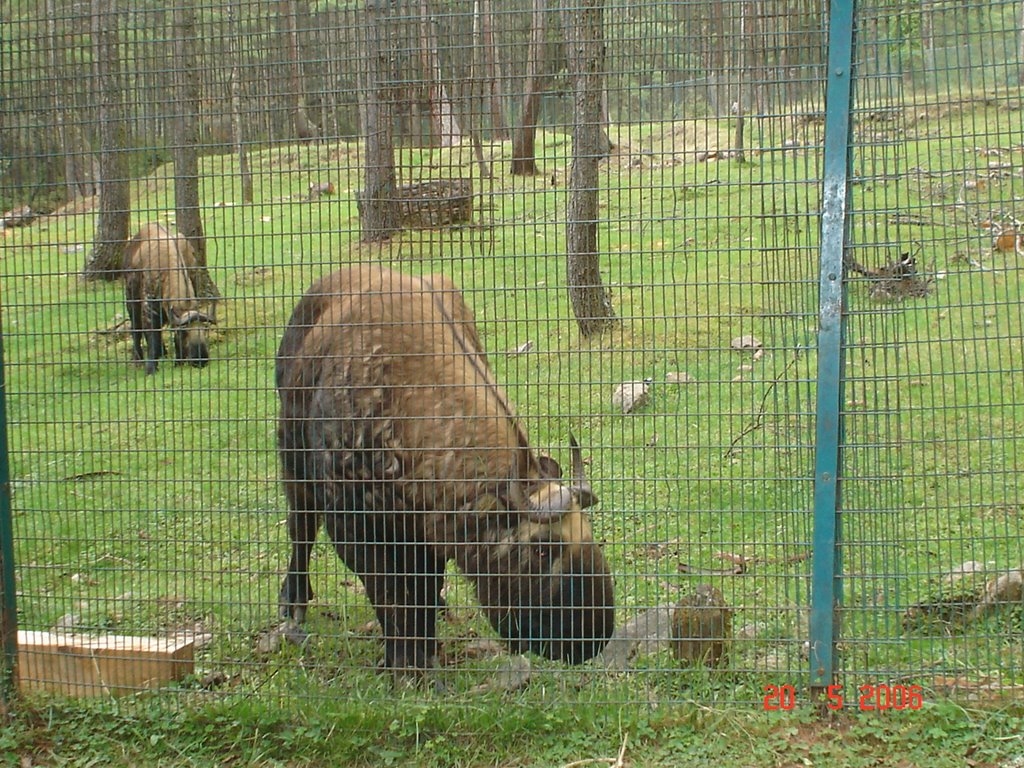
On the way was a stop at the Takin Reserve. Takins are Bhutan’s national animals. A colourful bit of local myth says that they were created when the locals pestered one of the more eccentric monks for a miracle. The good man asked for a cow and a goat and devoured the two <> and then created an animal with the cow’s body and the goat’s head. Thus emerged the Takin, with an IQ of roughly 25 since clearly the mutuation had been too much to handle for the animal. Befuddled modern day taxonomists classify this animal in its own class on account of various reasons other than appearance. Sometime in the past, when Bhutan decided to add a zoo to its list of tourist spots, the Takins were among the star attractions. However, it was later decided that zoos are a bit cruel on animals and the animals were let loose. The Takins apparently were at a loss on how to react and spent their time regularly being killed at traffic accidents and such, till finally the Bhutanese decided to create a wild life reserve to save the Takins from themselves. The reserve is about 8 acres and tourists can walk around a wire fence through which the Takins can be seen. All of us did exactly that, armed with our cameras. I have a nice Sony 4.1 mega pixel camera with much functionality. One of those functionalities is a switch that allows me to turn off the flash. Something I did not discover till later. So when one of the Takins finally came close enough for a decent shot, I let my shutterbug instincts lose. The stupid flash in my camera scared the Takin out of its wits. The bulky Takin sprang towards me with surprising agility. Then, I got scared out of my wits and inspite of knowing that a strong fence separated us, sprang back with even more surprising agility. At the end of this happy performance, a decent distance separated both Takin and self from each other and I decided not to take snaps of any more animals.

Shaken and stirred, I looked forward to the calmer environs of the telecom tower. This is one of those U.S. type attractions – completely insipid, created to keep the tourist happy that they have more one place to tick off on their checklist and with mediocre photo opportunities. All of us dutifully posed for a snap. W went one step beyond and helped a couple of young Bhutanese women struggling with the lyrics of a Bollywood song.

On the way back was our big Royalty moment. The king’s cavalcade, comprising his car with the license plate reading ‘Bhutan’ and a smart police vehicle led the way. The other cars on the road stopped. Like good tourists we gawked as the Queen’s entourage followed at a respectful distance. S’s theory was that since the royalty was another star attraction, possibly there are plenty of such cars whizzing up and down to give tourists a bang for their buck. My theory was that with a population of roughly 700000 people, everyone is bound to bump into everyone else over a 10-day period. All of us were thrilled though to see in flesh and blood, albeit through tainted glasses, the man whose picture we had seen in every single establishment in Bhutan.

The next stop was the Decchen Phodrang Monastery. This was again bereft of adult supervision being a Sunday. The boisterous bunch of child monks though made up with their enthusiasm and eagerness to get snapped. W obliged and clicked as many pictures as possible. The monastery itself was beautiful, perched on a hill, overlooking rice fields. You could just sit on one of the roofs and watch the countryside for hours.

Finally it was time to tackle LP’s number one spot – the Drashi Choe Dzong. This is the main admin office of the country, with the King and a couple of senior members of his cabinet having offices here. The Parliament is located just across, separated by a river. The Dzong is majestic to say the least. Unfortunately we could not enter the premises since we had to have permits and permits are given only to Bhutanese tour guides. The simplest solution would have been to tell the hotel to arrange for a tour guide for an hour, but we did not have that kind of time.

Our stay that night was at the Wangchuk Hotel, located close to Norzin and Chorten Lams, Thimphu’s main market area. Lam means ‘road’ but to the Bhutanese sullying places by categorizing them under proper names is probably a sin. Whenever you stop to ask people for directions to a place, they never tell you which roads to take, instead give you directions based on various landmarks. At any rate, Wangchuk Hotel was located conveniently close to the shopping center and we could just pop out and pick up bargains. Which is exactly what P and self did while the guys decided to catch up on their sleep.

Shopping in Thimphu involves a decent bit of bargaining. Unfortunately shops close by eight on Sundays and hence at 8.15 we found ourselves on practically deserted streets. The next step was to find a decent place for dinner that served momos. The hotel’s sulky waiter had sulked throughout tea and clearly informed us that we would not get momos. In the event, we ended up having dinner at the Zone 1 pub. They served pizzas instead of momos but the cheerful owner played an extremely funny video on Bushisms compiled by Slate magazine and another equally funny Robin Williams stand up comedy show. I sat transfixed watching TV after months of watching largely tamil and hindi music channels in Chennai. I went to sleep happy and contented.

Bhutan - Day 1 - Paro


Bhutan can be entered by air or road. The most common entry point by road is Phuentsholing, a town separated from India by an innocuous looking arch. Phuentsholing is a roughly three-hour drive from New Jalpaiguri where the railway station is located or Bagdodara where the airport is located. S and W had taken the train from Cal to NJP. From there Rajesh, the driver, picked them up in his Sumo and had taken them to Thimpu via Phuentsholing.

P and self were flying down to Paro, Bhutan’s only town with an airport, from Cal by Druk Air. Druk Air is the national carrier and no other airlines are allowed to operate. LP had promised us that the flight would be good, and it certainly was. The Himalayas loomed upon us as we began to land and the pilot assured everyone that if it looked like we were going to crash into the mountains, we were not to worry. Not a traditional announcement but reassuring in the circumstances.

The plan was for S and W to drive down from Thimpu to the Paro airport and pick us up. They had been under the assumption that we would land around 11 and our phone call informing them that we would be reach by 9 had hastened matters but not sufficiently. P and self got our first taste of Bhutanese friendliness right there in the airport where practically everybody asked us if they could help. One of the more helpful chaps was an airport security officer called Jimmy. When the guys finally arrived and we were to leave he informed us that there was a DJ from Delhi playing that night in Paro’s only disc and we should try and make it. P and self felt like minor celebrities.

The first stop was to be the Druk Air office to cancel tickets Pallab had overbooked by mistake . S and W had had sufficient time to get used to the pretty buildings but P and self were overwhelmed by the architecture that comprised ornate windows set in neat looking windows. There were also chortens all over the place. Out came the cameras and the first of a long series of snaps was clicked. The Druk Air office was bang opposite the Paro Dzong. Dzongs actually mean fortresses and were used such in ancient times. But with a rather obvious lack of need to defend various villages now, the buildings were converted into administrative offices. The Paro Dzong was especially beautiful since the Paro river flowed practically by its front door. Infact the main road in Paro is built along the river and your trips are accompanied by the sound of water over pebbles.

Our first meal in Bhutan. We landed at a place called ‘Sonam Trohpel’ on Paro’s main street. P had made up her mind that she would live on momos for the entire length of the trip. We ordered other local specialities – Kewa Datshi <> and Hindsey Datshi . Every dish seemed to be made with butter. Clearly not a diet recommended for anyone aspiring being a super model. And this did not even include the inexpensive beer.

Post lunch visit was to our first and last obviously tourist place in Bhutan - Paro museum. Bhutan has a fairly long history with relics from as long ago as 4500 years ago. However most of the information tends to be on Buddhism and unfortunately after a while you tend to get a bit lost in the various important figures in Buddhism. The most entertaining collection seemed to be that of stamps. For some reason, Bhutanese people have been completely fascinated by events outside of their world, especially the U.S. and U.K. So there were stamps commemorating the landing on the moon and Walt Disney characters. The final floors housed a collection of Bhutanese vessels in a low-ceilinged, narrow passage where Agatha Christie murders could have been set. The curator had also cleverly tucked away vast urns in every nook he could find. A post prandial walk is never the best setting to admire the beauty of a 100 similar looking urns and we finally got out of the maze and left.

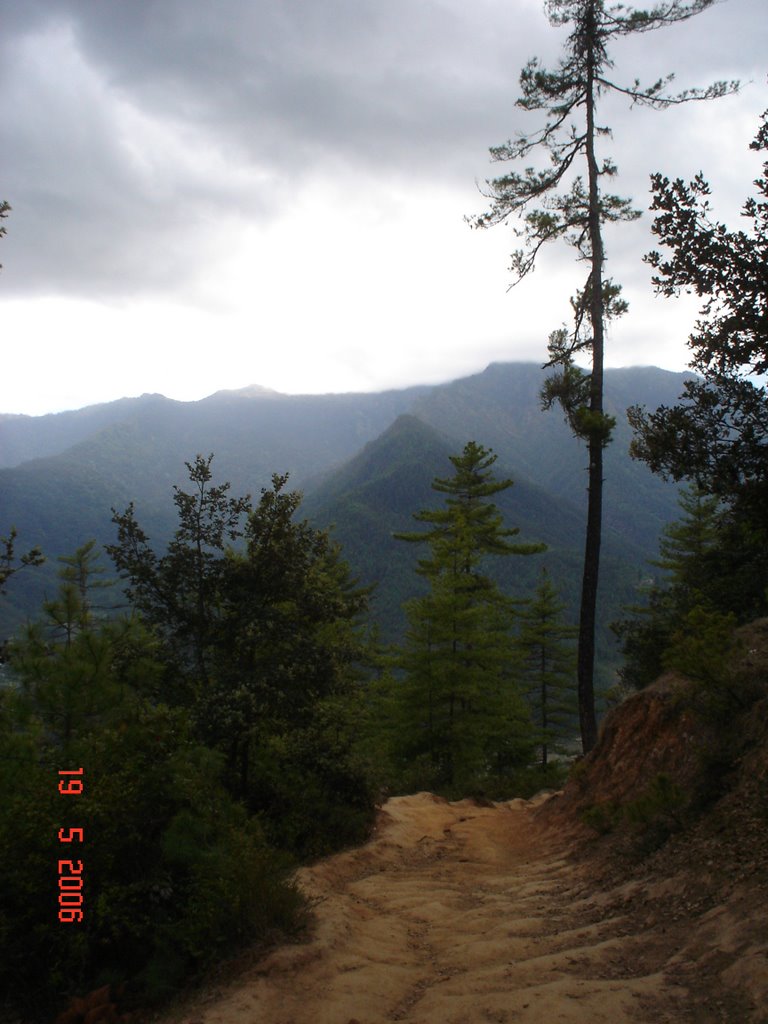
With a little bit of light walking done, we were ready to tackle Paro’s best attraction – the Taktsang Monastery. Tradition has it that Guru Rinpoche had flown down to this rock on the back of a tiger. A casual observer can readily vouch that holding onto a flaming tiger is probably a less stressful way of reaching the place than the trek up. It was 3.45 p.m. by the time we set out. By the time we had walked 10 minutes I was definitely breathless. It was much later that I realised that your pace has to be changed for walks on altitudes at this level. P turned back around after half an hour and spent the rest of the time sleeping in the jeep and drinking tea. W, the fittest of the group bounded ahead. S soon disappeared into the upper slopes. I trudged on with the group’s supply of water and food and feeling too guilty to abandon the trip in case the guys came back for water. In the event it turned out to be a brilliant trek once I started to pace myself better. At around 5 when I figured that I would not make it to the top before sunset, I decided to quit. The walk back was even more brilliant. The skies were graying, a light drizzle began and the full beauty of the Himalayas hit me. After a brief while, S caught up with me and we reached down. All three of us ordered another round of hot chai and waited for W to arrive and announce his conquest. Sure enough, by 6.30 he was in the jeep bursting with stories about the view from the top. Sadly the monastery had shut at 5 and he could not get in.

By this time, the toll of waking up at 4 a.m. was beginning to tell on me and I was glad it was time to check into our hotel. That night’s stay was to be in Olathong. Fairly expensive by Bhutanese standards – 2000 rs a night whereas most other places are between 1250- 1500 rs a night for two people. The hotel was nice and comfortable though. The food at the buffet was terrible though. But all of us were on a high after the first day of the vacation and did not mind too much.


31 May 2006

Bhutan - Prologue

Every trip has a beginning. Ours can be best described as a series of random events materializing into a road trip. W had sent a mail to our B-School batch e-group saying that he was planning a road trip to Bhutan and if anyone was interested, we could mail him back. My colleague P and myself had been making halfhearted research on a Konkan coast backpacking tour. The Bhutan idea sounded better. I mentioned it to S casually during a phone conversation. S got in touch with W and signed up.

Of course there were the obstacles that work throws up. One of life’s standard rules is ‘Your indispensability at work is directly proportional to how much you are looking forward to your vacation’. Eventually it was decided that W and S would go by road from New Jalpaiguri to Thimpu on Thursday. P and self would land in Paro by air on Saturday whence the other two would meet us.

This was one of those perfect trips for me. I had to do absolutely no planning but wait for terse instructions from W on the lines of ‘scan your passport and sent it to Pallab’ etc. Pallab was the tour organiser and a few conversations with him revealed that he was a bit scatter brained. Not having to interact frequently with him could keep your blood pressure down. W’s Sikkim trip had been organised by Pallab and W was sure he could manage the Bhutan bit too.

With nothing much to do, the part of me that loved organizing decided to contribute by buying a Lonely Planet guide. Frequent travelers would have noticed that you could surf online for practically all the information you need to know to go to any place. But armed with a Lonely Planet guide, you suddenly feel like the seasoned backpacker rather than the amateur tourist. LP told me all I needed to know about its food , royalty and a variety of other highly indispensable stuff.

Finally it was D-Day. P and self scooted from office at 3.45 p.m. to make it to a 5.30 p.m. flight to Kolkatta

25 Apr 2006

KR Hills trekking

KR Hills is a nice scenic spot near Shimoga. It is apparently a popular tourist destination. Especially if you go by the number of tourists who manage to make their way from nearby areas to the place

We set off from Bangalore on Saturday morning with CARE Adventures. As expected, the bus was filled with software engineers. Software engineers are an interesting bunch of people, especially if you see them as a sample in a socio-psychological experiment. They spend all day in office in artificial light, stale air-conditioned air and interacting with other s/w engineers. Not surprisingly as a community they end up with a sense of humour on par with the principal characters of a David Dhawan movie. The entire 12 hours we traveled in the bus was a non-stop riot of jokes that made you want to pull your ears out and stuff them into your bag.

The bus journey from Bangalore took about 6 hours. On the way we stopped for breakfast at the A1 Plaza built by Reliance – a handy outlet that serves very limited variety of food but prides itself on hygiene levels. The next break had a more local flavour, with tender coconuts and the like. We reached KR Hills and checked into some rooms for a quick wash. After that we were off on the ‘trek’.

The trek turned out to be a walk. The trail was bursting with tourists. The women wore bright sarees and high heels. The children were not treading carefully on the ledges but running forward. All of us, on the other hand, were dressed like people in the brochure for a Himalayan trek and consequently provided some light entertainment to the tourists.

We reached a reasonably high point after an hour of brisk walking. There was a gentle breeze, the sun was not so hot and overall the walk seemed worth it. Then three of us walked to a very nice point from where there was a spectacular view of the setting sun. The sun glowed a fiery yellowish-orange and even as we watched, the colour began to gradually turn more sober, rising up from the bottom till the whole ball was a dull but strong orange. The nearby clouds began to look gray and the valley, which spread out before us, glistened for a while before settling down to a verdant calm.

By this time the rest our gang was nowhere to be found and we made our way back to the rooms. There we found everyone gathered at a table ready to gulp cups and cups of hot tea and pakoras. Gleefully we followed suit. As night fell, the power went off. So for a couple of hours some of us waited in the dark as most of the S/W engineers went off to do a complete makeover in the dark. Presumably even this little bit of exposure to other people makes them suddenly realise that this is the time to flash that expensive make up and clothes.

Well past our original schedule we arrived at our campsites and lit a cheerful fire. Before the raucous singing could begin and drown out the sounds of the night, the rain gods rescued us. Everyone jumped into the tents. There was a brief respite in the rain while we ate and then it began to pour again. Water began to seep through the thermocol floor of the tent. Luckily it stopped before it could soak the sleeping bag in which I was huddled.

There is something to be said about waking up and walking to the edge of the cliff where your tent is pitched and seeing the mist rise slowly from the valley. Enthralled, we sat and gaped for a while before getting ready for the day’s trek. That day was to be entirely downhill and through a nice forest cover – enough to keep out the sun but not so much that you would be in close contact with lurking snakes.

Thanks to the rain, the weather was excellent and we made good progress. Our trekking guide, G, had made up his mind long ago that the best way of dealing with the laggards was to ignore them and pick them up on the way back in case they did not make it to the waterfall we were planning to reach. G was a short and wiry guy who lived on nicotine. Every time we took a break, he would pull out a cigarette and go about aiding his already blackened teeth into permanent decay. G had no clue how to get the S/W guys to stick to the schedule and following his new plan of action began marking elaborate signs on the ground for the others whenever we had to make a detour. At some point G gave up even on that and decided that if it were meant to be, the gods would find a way to get the entire group to the waterfall. Mercifully, everyone reached.

The braver people managed to get into the waterfall and shiver away for ten minutes before getting out. Most just sat around and felt the cool spray of the gushing water on their faces. After all the walking, the sight of the lush green trees, sparkling water and dry rocks on which you could perch was very calming. Soon it was time to leave and a longish bumpy ride back in a jeep brought us back to the rooms.

The return journey to Bangalore began little later than scheduled. Since I had to catch a train G got worried and began to handle the situation in his usual style - avoiding direct eye contact with me, urging the driver to go fast and smoking gloriously. It was entertaining for a while but when it looked like we would all ram into some oncoming vehicle thanks to a charged up driver, I told him that my train was later than he thought. Immediately he called for a tea break and began to smoke in relief.

We reached Bangalore at a reasonable hour and went our separate ways. I had taken a sum total of twelve photos to record this experience. The s/w guys sent the entire group their snaps the next day. Which was probably the only good thing about the group since they had taken 185 snaps and some of them were really terrific. Well, nice trek, nice snaps and Ok crowd. 2 out of 3 ain’t bad


Review - The alchemy of Desire

Let me start on a defensive note. I borrowed this book mistaking Tarun Tejpal for Aniruddha Bahal. I had enjoyed Bahal's Bunker 13 and decided this had to be good. By the time I realised my error, I had started to read the book and the book seemed reasonably promising. Sadly I had not read the many reviews that had apparently trashed this book.
The book’s front flap indicates that the book is about the lives of young Indian couples in today's day and age. I think most readers would differ. Especially when they come to the historical bits. But wait, I am running ahead. The story starts off with the protagonist and his wife breaking up inspite of the great sexual chemistry they have. The book traces the lives of the two for a while. Then comes the twist in the tale and the couple breaks up and the book goes downhill from thereon. The first half is so realistic that you are waiting for a really strong reason for the break up. Which does not happen. The silly story ladled out makes you wonder if Tejpal overdosed on Hollywood movies about enchanting India and Maharajahs and slaves and princesses before writing the second half. You stop caring about the couple and by the time the time you reach the end of the book, you begin to skim and indifferently finish the book.
Note to myself: Aniruddha Bahal is not Tarun Tejpal. Remember.